
Daviess County Arrest Records and Court Charges
Arrest records in Daviess County usually point to the booking event. The Daviess County Detention Center says current housed inmate public information can include name, age, arrest date, charges, and bond information. That is not the same as the full court case file. Booking data can show why a person is held now, while the official charge record is read through the court, the Circuit Court Clerk, KYeCourts, or an AOC criminal record report when the record is public.
Court charges after arrest are narrower than a full criminal court record. A charge record may identify the alleged offense, charge date, citation or control number, court, bond, amendment, and current status. The full case file and final outcome are handled as Daviess County criminal court records, while the jail roster and booking details belong with current custody records. The distinction matters because one arrest can produce several charges, and one charge can later be amended, reduced, dismissed, or carried forward to sentencing.
The official DCDC inmate lookup page links to the current roster interface. See the DCDC inmate lookup entry page for the custody side of Daviess County arrest records.
This jail lookup is useful for current booking facts, but court charge records still need confirmation through the court or prosecutor-filed case record.
Find Daviess County Arrest Records
The most reliable charge check starts with the record type. For a current inmate, use the DCDC roster or the official JailTracker/Public Safety Cloud roster linked from the jail site. For filed charges, use KYeCourts guest public records or contact the Daviess County Circuit Court Clerk. For a formal statewide criminal record report, use the Kentucky Court of Justice AOC criminal record report process. DCDC also has a written open-records process for jail records not shown online.
- Check the DCDC inmate lookup if the person may be in custody now. The public jail data can show arrest date, charges, and bond.
- Use KYeCourts for public case context, including case number, party search, citation search, and charge or disposition clues when available after captcha.
- Call or visit the Circuit Court Clerk when a certified copy, older case file, or official case review is needed.
- Use the AOC criminal record report when the request is for a statewide report rather than a single Daviess County case file.
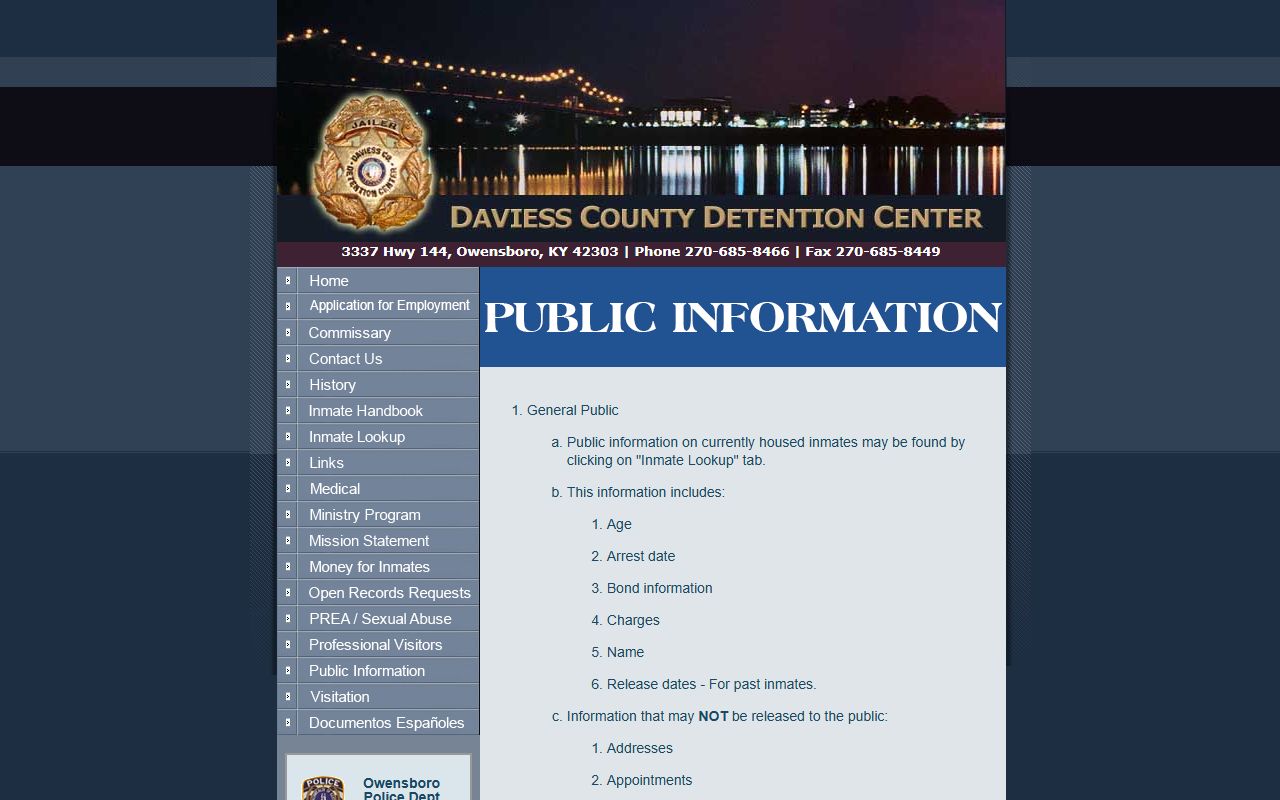
DCDC public information states that some details are public and some are withheld. The jail does not release court dates, dates of birth, addresses, cell locations, medical information, PREA information, inactive records, current inmate release dates, Social Security numbers, or transport details. That limit is why Daviess County court charge records often need a clerk or court search even when the jail record confirms the arrest.
The DCDC public information page lists what the jail releases to the public and what it withholds.
Those limits keep the jail lookup from replacing the Circuit Court Clerk as the official source for court charge status, court dates, dispositions, and copies.
Daviess County Charges After Arrest
After an arrest, a formal charge may reach court through a complaint, information, indictment, citation, or related charging paper. In Daviess County, misdemeanors, violations, traffic offenses, arraignments, and felony probable-cause hearings are District Court matters. Felonies and capital offenses move through Circuit Court. The County Attorney prosecutes adult and juvenile District Court matters, while the Commonwealth's Attorney prosecutes felony-level Circuit Court cases for the 6th Judicial Circuit.
| Document | Who Uses It | How It Fits a Daviess Case |
|---|---|---|
| Complaint | Law enforcement or prosecutor | Often starts a District Court criminal matter or supports probable-cause review after arrest. |
| Information | Prosecutor | Can state formal charges filed by the prosecutor where Kentucky procedure allows that path. |
| Indictment | Grand jury | Used for felony accusations that proceed in Circuit Court after grand jury action. |
Charge language can shift as the prosecutor reviews police reports, witness information, evidence, and any plea negotiations. An original charge on a booking record may not match the final court disposition. AOC criminal reports can include county of origin, case number, original charge, amendments, disposition, charge date, disposition date, and necessary clerk memos. That report is better for final charge history than a current jail snapshot.
Daviess County Charge Status
A Daviess County court charge record should be read at the charge level, not just the case level. One case can have several counts. One count may be amended while another is dismissed or resolved by plea. KYeCourts results are captcha-gated, so the research did not verify live Daviess result columns. Still, official AOC report descriptions and court-record fields show the charge date, original charge, amendments, disposition, and disposition date as key facts.
| Status | What It Means | Where to Confirm |
|---|---|---|
| Pending | The charge is filed but has not reached final disposition. | KYeCourts, docket search, or the Circuit Court Clerk. |
| Amended or reduced | The filed charge changed from the original charge, often after review or plea talks. | AOC criminal report or official case file. |
| Dismissed | The charge ended without a conviction on that count. | Court disposition and clerk copy. |
| Convicted | A plea or finding established guilt on that charge. | Court disposition, sentencing order, and AOC report. |
| Sealed or expunged | Public access is restricted or the record is removed from official systems as statute directs. | Issuing court and statutory expungement order. |
Bond is another field that can confuse a search. Bond information in the DCDC roster says what amount or type applies to current custody. It does not prove guilt, and it may not show the final court result. Court costs, restitution, fines, and payment status are separate court financial fields that may appear later in the case.
Note: A public charge is an accusation until a plea, verdict, or other final court disposition changes its status.
Charge Records vs Convictions
A charge is not a conviction. It is the accusation placed before the court. A conviction is the result of a guilty plea, guilty verdict, or other qualifying finding. Daviess County arrest records can show charges tied to an arrest even when the court later dismisses, amends, or resolves them in a way that is not a conviction.
| Point of Comparison | Charge | Conviction |
|---|---|---|
| Record stage | Early accusation after arrest or citation. | Final or enforceable finding of guilt. |
| Common source | Booking record, complaint, citation, indictment, case docket, or AOC report. | Disposition, judgment, sentence, and criminal record report. |
| May change | Yes. It can be amended, reduced, dropped, or dismissed. | It can be appealed, vacated, or expunged only through proper legal process. |
| Use in screening | Needs care because it may not be final. | Still must be verified and used only within legal limits. |
Important: Do not treat a Daviess County charge entry as proof of conviction without checking the court disposition.
Jail Context for Charge Records
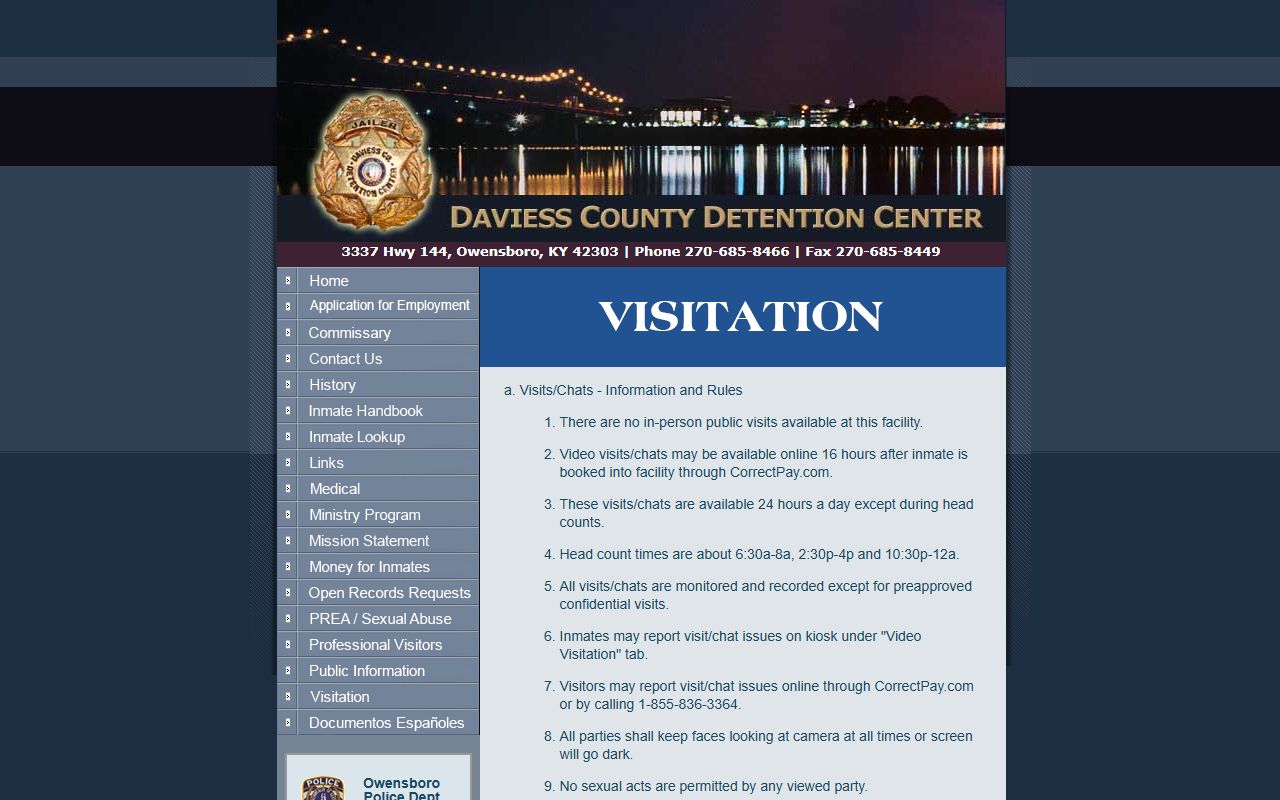
Some arrest-to-charge searches lead to jail services because a current inmate may need visits, deposits, commissary, or open-records help while the court case is pending. These services are not court charge records, but they explain why a person may be visible in the DCDC roster before the final court result is known. DCDC says video visits and chats are handled through CorrectPay, and public visits are video-only.
The DCDC visitation page explains the video-only visit system and head-count blackout periods.
Visitation rules can confirm custody procedures, but they do not identify whether a charge was reduced, dismissed, or resolved in court.
The jail also publishes inmate account rules. The DCDC money for inmates page describes kiosk, mail, online, and phone deposit channels.

Deposit activity is a custody-service issue. It should not be read as evidence of charge severity or a final court outcome.
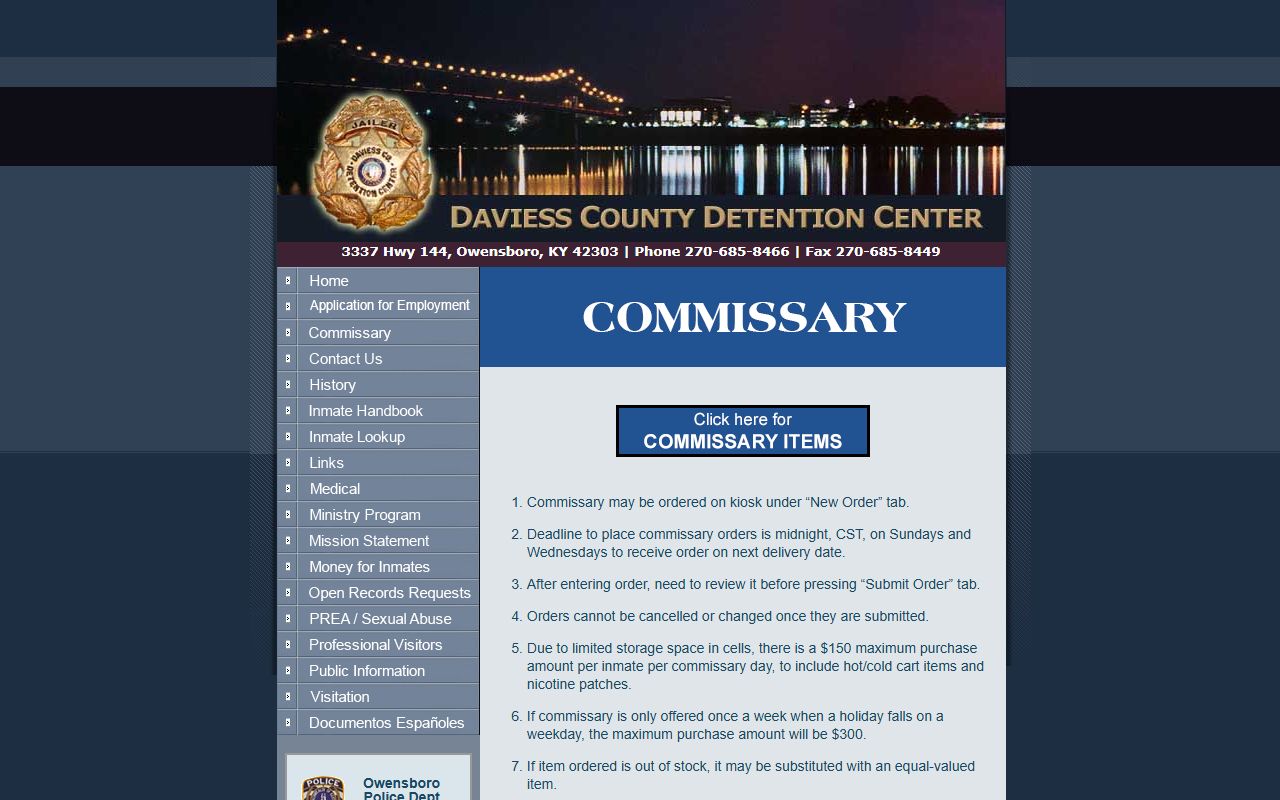
The DCDC commissary page gives order deadlines and public gift-basket rules for housed inmates.
Commissary records are not court records, but the page can help confirm that the person is tied to DCDC rather than state prison or another agency.
Daviess County Prosecutor Roles
The charging office depends on the level of the case. The Daviess County Attorney, Hon. John Burlew, handles adult and juvenile matters in District Court, criminal complaint forms, misdemeanor restitution, guardianship or medical warrants, and the Drive Safe Program. The Criminal Division is in the Robert M. Kirtley Judicial Annex behind the Morton J. Holbrook Center. The criminal division phone is 270-685-8429.
The Commonwealth's Attorney for the 6th Judicial Circuit handles felony prosecutions in Circuit Court. Research identifies Hon. Mike Van Meter, also listed as John Michael Van Meter, at 117 East Third Street, Second Floor, P.O. Box 767, Owensboro, KY 42303, phone 270-687-7451. If a Daviess County charge moved from probable-cause review to felony indictment, the Circuit Court case and Commonwealth's Attorney role become central to the record.
Daviess County Attorney Criminal Division
Robert M. Kirtley Judicial Annex
100 East 2nd Street, Owensboro, KY 42303
270-685-8429
District Court adult and juvenile prosecutions, complaint forms, and misdemeanor restitution.
6th Judicial Circuit Commonwealth's Attorney
117 East Third Street, Second Floor
P.O. Box 767, Owensboro, KY 42303
270-687-7451
Felony-level Circuit Court prosecutions for Daviess County.
Public Access to Daviess Charges
Kentucky public-record access begins with the custodian. For court case files in Daviess County, the custodian is the Circuit Court Clerk for the court that heard the case. The Kentucky Court of Justice says AOC does not maintain court case records for copy requests. Daviess arrest records held by the jail use DCDC's open-records process, not the Circuit Court Clerk's process.
KRS 61.872 allows Kentucky residents to inspect public records unless an exception applies. KRS 61.878 permits withholding or redaction for exempt, confidential, privacy-sensitive, investigatory, or security-sensitive material. These rules help explain why a public charge may be visible while birth dates, addresses, court dates in jail records, medical data, or juvenile materials are not.
DCDC written open-records requests go to the Official Custodian of Records, DCDC, 3337 Hwy 144, Owensboro, KY 42303, or openrecords@daviesscojail.org. The request must be signed and dated, state Kentucky residency, include an address, include a phone number if possible, and describe the requested jail records in enough detail. The jail states the written response is due within five business days, starting the day after receipt, and copies cost $0.10 per page plus postage.
Restricted Daviess County Charge Records
Not every Daviess County charge record is public. Juvenile court records are confidential under KRS 610.340, with access limited to persons allowed by law or court order. Adoption, dependency, neglect, abuse, termination-of-parental-rights, and mental-health records should not be described as ordinary public case records. Sealed and expunged matters are also removed from public systems as the law directs.
| Record Type | Public Access Impact | Research Basis |
|---|---|---|
| Juvenile charge or family matter | Generally confidential unless a statute or court order permits access. | KRS 610.340 and Family Court restrictions. |
| Expunged charge | AOC criminal reports do not include expunged or purged cases. | KRS 431.076, 431.078, and 431.073. |
| DCDC withheld fields | Jail withholds addresses, dates of birth, court dates, medical records, PREA data, and current release dates. | DCDC public information page. |
| Investigatory or security-sensitive record | Agency may redact or withhold exempt material while releasing nonexempt parts when possible. | KRS 61.878. |
Expungement is record-specific. Nonconvictions may fall under KRS 431.076. Eligible misdemeanor, violation, and traffic-infraction convictions may use KRS 431.078. Certain felony convictions may use KRS 431.073 after statutory conditions are met. A person checking Daviess County arrest records should verify the case number and final disposition with KYeCourts or the Circuit Court Clerk before assuming an old charge is still public.